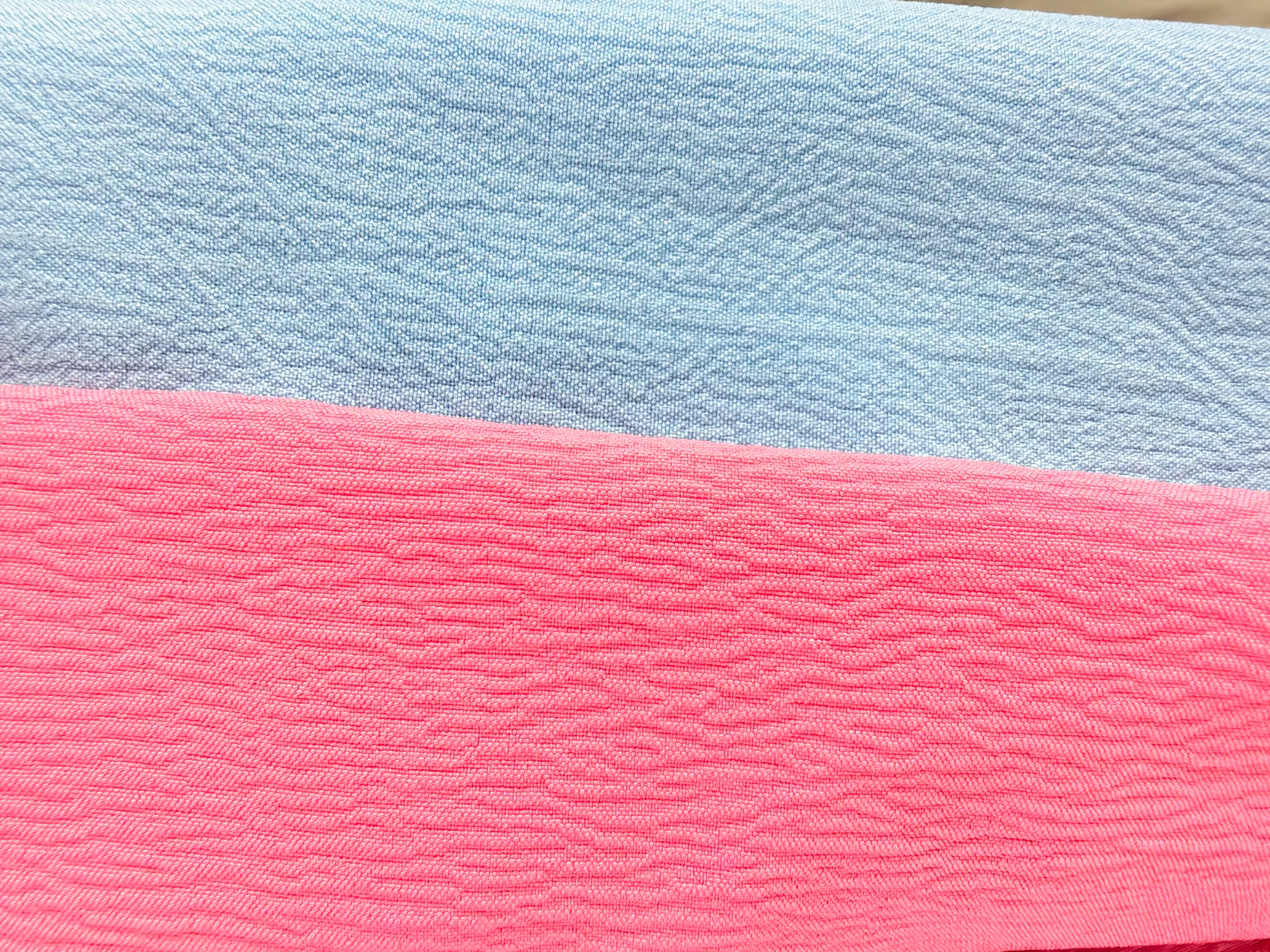
The same 100D four-way stretch crepe greige can become an organic crinkle or a neat ant crepe. See how the finishing choice affects garments, printing and price.
The finish can change the fabric's entire personality
In the modern textile industry, the magic of garment creation often lies far beyond the loom. Two pieces of cloth crafted from the exact same raw base can display vastly different visual personalities, surface textures and tactile hand-feels simply because their dyeing and finishing processes differ. The photograph above features 100D crepe four-way stretch woven fabric. At first glance, the sky-blue fabric on top and vibrant pink fabric below may appear to be different materials. In reality, both swatches originated from the same roll of undyed greige fabric. A single pivotal choice in the processing route transforms one raw weave into two distinct fashion aesthetics.
Why 100D four-way stretch crepe is a staple
Composition & Construction: Made with 100-denier high-twist polyester yarns blended with elastane or spandex, it provides stretch and recovery along both the warp and weft directions. Affordability: It is cost-effective to produce, which makes it a popular choice for high-volume fashion lines. Drape & Comfort: The high-twist yarn structure creates a lightweight, fluid drape that feels soft and breathable against the skin. Versatility: It is widely used in everyday womenswear and casual fashion, particularly for dresses, skirts, relaxed trousers and flowing blouses. While the raw greige fabric provides built-in elasticity and durability, its final visual texture depends on how those high-twist yarns are permitted to shrink during the dyeing process.
Direct dyeing: the organic crinkle route
The sky-blue fabric on top illustrates what happens when raw greige fabric undergoes direct dyeing. The untreated greige fabric is placed directly into the dye vat without preliminary smoothing or mechanical pre-setting. When high-twist crepe yarns encounter hot liquid inside the dye vat, they undergo rapid, unconstrained thermal shrinkage. Because no mechanical tension or pre-flattening restricts yarn movement, the fibres contract freely in multiple directions. The result is an irregular, organic and randomised crinkle texture.
The visual result: relaxed and natural
The blue fabric displays a relaxed, breezy and effortlessly artistic surface, with a subtle play of light and shadow. It has a bohemian, casual charm that feels natural and unforced. This organic crinkle direction is suited to consumers who prefer relaxed, casual, natural or vintage-inspired aesthetics; it is especially useful for resort-wear dresses, flowing maxi skirts, gathered blouses and easy-going wide-leg casual trousers.
Pre-flattening before dyeing: the ant-crepe route
In contrast, the pink fabric undergoes a specialised two-step process: pre-flattening treatment followed by dye-vat immersion. Before entering the dye bath, the greige fabric is subjected to a mechanical pre-treatment, such as tension-guided washing, stenter smoothing or controlled heat-setting, to level the surface and stabilise the web. Pre-flattening organises the internal tension of the twisted yarns. When the fabric subsequently enters the dye vat, thermal contraction occurs in a structured, uniform manner rather than randomly, resolving systematically along the transverse, or weft, direction.
The visual result: refined ant crepe
The resulting style is a fine, highly regular horizontal micro-ripple texture known in the textile trade as ant crepe. The pink fabric exhibits neat, linear micro-textures with fine, dense ripple lines. It delivers a structured, refined and elegant appearance. This route suits shoppers who appreciate neatness, subtle linear detail and tailored sophistication, and works particularly well for smart-casual trousers, pleated skirts, office-ready dresses and tailored tops.
One inventory, two design directions
From an industrial standpoint, this duality is a substantial benefit. A fabric mill can maintain larger stocks of one greige fabric, reducing manufacturing complexity and cost, while offering apparel brands two visually unique textiles for different seasonal collections. The story behind these two swatches highlights the hidden craftsmanship in modern textile production: whether to dye the raw fabric directly or flatten it beforehand turns one 100D four-way stretch greige fabric into either an organic, casual crinkle or a meticulously organised ant crepe. In textiles, beauty depends not only on what you weave, but on how you finish it.
Which garments suit each finish?
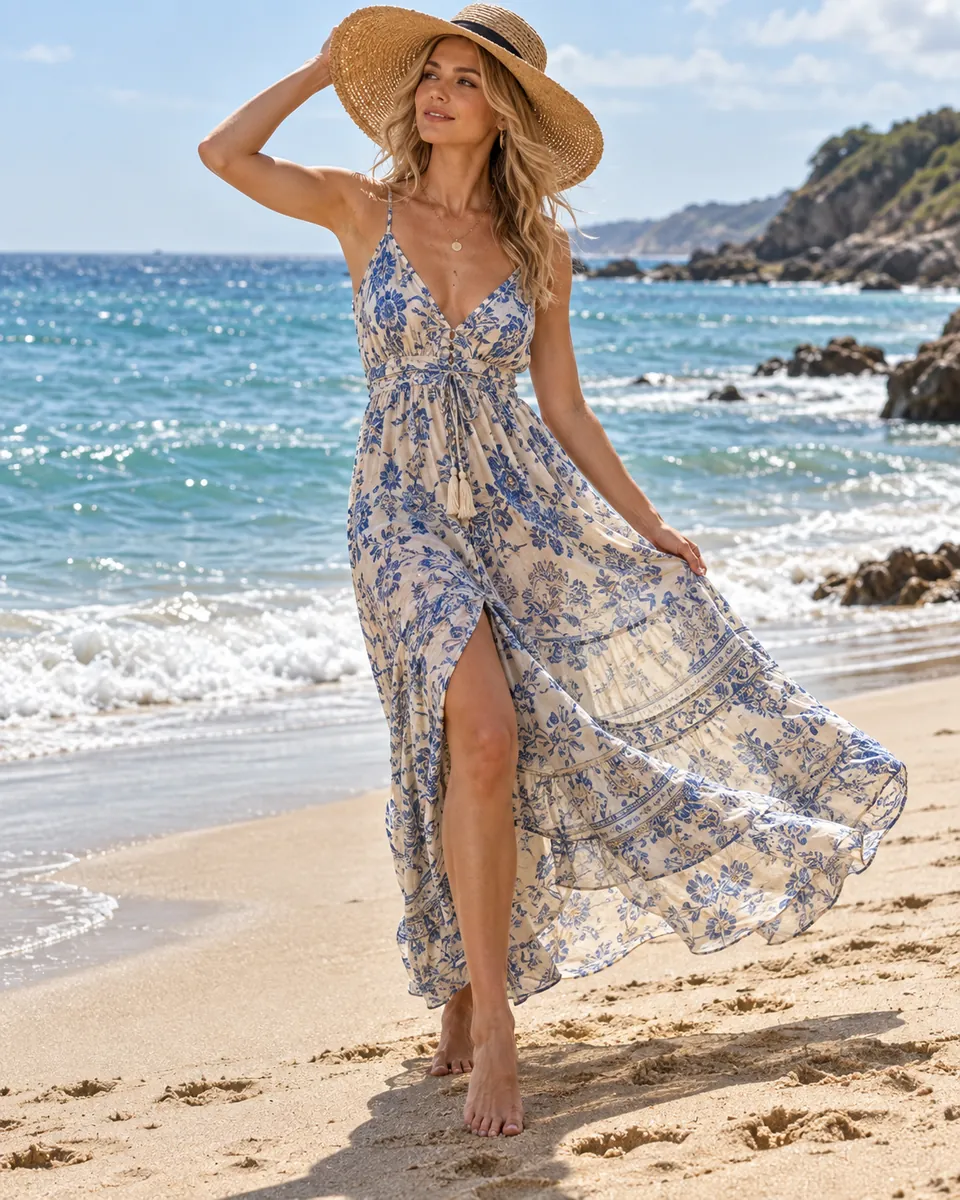
The choice between the blue organic crinkle and the pink, more regular ant-crepe surface is also a choice about the garment. The looser-looking crinkle reads well in easy summer dresses, tiered skirts, loose blouses and beach cover-ups: movement lets the uneven texture catch the light. A printed maxi dress can turn that same relaxed surface into a resort piece without changing the base greige. The neater transverse ripple suits shirt dresses, smart-casual skirts, relaxed trousers and simple tops when a cleaner outline matters.
There is room for T-shirt-style garments too, especially a boxy tee-shaped blouse cut from this woven stretch cloth. It will not behave exactly like a conventional knitted jersey T-shirt. A pattern maker should allow for the fabric's actual stretch, recovery, drape and seam construction, then test the neck opening and shoulder fit. For any style, ask for the finished width, weight, composition, opacity and wash shrinkage of the chosen finish before cutting. The photograph at the top shows the real two-finish fabric. The beach look below is an editorial garment concept, not a photograph of a dress made from those swatches.
Digital and conventional wet printing can broaden the range
A plain dyed cloth is only one possible offer. The same greige can be prepared for a print route, giving a buyer floral, geometric or location-specific patterns as well as the two surface effects. Digital textile printing makes sense for testing several designs or shorter runs because artwork can change without preparing a screen for each color. Conventional wet printing, including screen or rotary methods where suitable, becomes attractive when a repeat pattern and order size justify its set-up. A printer must choose a colorant and fixation route appropriate to the actual polyester–elastane composition; EFI Reggiani, for example, specifies a water-based disperse-sublimation ink for polyester and elastomer fabrics in both direct and transfer applications. [1]
Do not assume that the already-dyed blue or pink swatch is ready to receive a light, sharp print. A print program may call for a prepared white or pale base, and the chosen pre-treatment can change surface regularity, color appearance and pattern registration. Ask the print house to strike off both finish directions if both are to be sold. Check pattern scale on a full garment panel, not only on a hand-sized square. Then test colorfastness, stretch recovery, dimensional stability and whether the printed motif distorts when the cloth is pulled. Those checks matter as much on a low-priced everyday top as on a beach dress intended to move in the wind.
This combination makes a broader line possible without commissioning a different greige for every garment: one base cloth can support plain-color skirts and tops, small digital-print experiments, and a larger conventional-print order after a design proves itself. A resort print might become a long dress, a matching skirt and a loose tee-shaped top. The opportunities come from pairing a familiar base fabric with a finishing and print route that has actually been sampled, rather than assuming every print process will produce the same hand or stretch.
What the price can support—and what it cannot
For this familiar 100D four-way stretch crepe, a Keqiao market practitioner puts the combined greige and routine dyeing cost at roughly CNY 3 per meter. Quantity, color and process route can move that figure. After a fabric trader's margin and tax, a common finished-fabric selling level is around US$1 per meter, again with normal variation by order size. These are supplied market guide figures for the ordinary base product, not a live offer for every specification. Printing, special finishing, export freight, import duty and garment making are separate costs unless a supplier explicitly includes them.
That cost level helps explain why the cloth works in price-sensitive, fast-moving apparel lines. A buyer can use an established greige and keep the first range narrow while placing repeat orders on colors that actually sell. Low fabric cost also leaves room to spend on a good print and a specific fit for a more individual product, such as the breezy printed beach maxi dress pictured above. The wholesale fabric price alone does not tell you whether the finished dress can be sold profitably: consumption per garment, cutting loss, lining, sewing, packing, returns and sales costs still have to be counted.
Ask a supplier to quote one agreed width, weight, composition, finish and shade at several meter quantities. Price the plain dyed, digital-print and conventional-print versions separately. If two quotations are far apart, compare the actual route and minimum per color or print design before deciding that one is expensive. The useful question is not simply whether this crepe is cheap. It is which finish and print combination gives the garment your buyer wants at a repeatable total cost.
The title, description and first seven sections were extracted in order from the named Jocrowntex local article. Added garment and printing guidance was checked against a textile ink manufacturer. The price guidance comes from a Keqiao practitioner supplied for this publication. The resort-dress image is AI-generated editorial art.
The supplied CNY 3 per meter combined greige-and-dyeing cost and approximately US$1 per meter finished-fabric selling level are indicative for the ordinary base product. They vary with quantity and requirements and exclude added printing and export-related costs unless a supplier specifies otherwise.